What ongoing care covers, and what it does not
Support is easiest to compare on five questions: how complex the site really is, what it depends on, what monitoring and recovery evidence exists, who is responsible for each part, and which changes are included. A monthly figure tells you almost nothing on its own.
The second thing to settle is what care is not. Redesigns, search programmes, new features and large content projects carry their own scope and price. An arrangement that quietly absorbs them gets rationed later.
The workflow below uses a made-up example rather than a client: a service business with a public enquiry form whose messages are delivered by an external email service. Nothing in it is a confirmed contract, platform version, service level, backup or completed test. The site owner approves content and holds renewal access. The support lead performs the agreed checks.
| Workflow step | Assumed actor | Proposed response | Exception | Acceptance evidence to collect |
|---|---|---|---|---|
| Review dependencies and access | Site owner with support lead | Inventory the domain, hosting, form delivery and renewal owners, recording every gap | An unknown credential or unowned renewal becomes an agreed action, not a resolved item | A dated dependency and owner inventory that preserves the unknowns |
| Prepare an update | Support lead | Review the change, pick a test environment and verify backup and restore evidence before an agreed release | Missing recovery evidence or a failed enquiry check pauses the release | Version notes, backup scope and test observations, recorded without assuming a result |
| Investigate a broken enquiry | Support lead with site owner | Check the affected path and the external delivery dependency, then agree a correction or a recovery | Lost access or uncertain backup scope escalates rather than producing a restoration promise | Incident times, affected-path observations and a recovery decision |
Read the rows as a comparison tool. Each names who acts, what would stop the step and what you should see afterwards. Ask any provider for those three things per activity. A proposal that only describes the middle column has not said who is accountable for it.

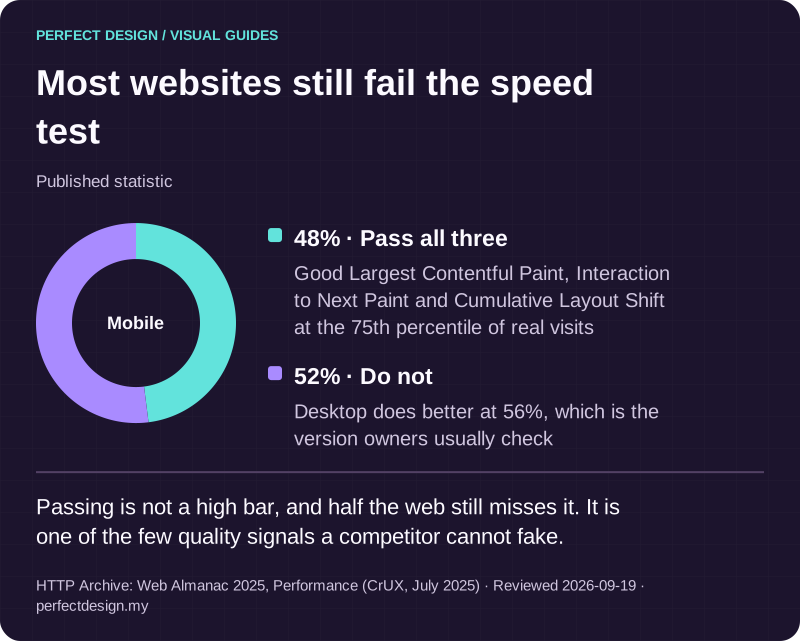
Most websites still fail the speed test
Published statistic. Passing is not a high bar, and half the web still misses it. It is one of the few quality signals a competitor cannot fake.
Source: HTTP Archive: Web Almanac 2025, Performance (CrUX, July 2025). Reviewed .
Read the graphic as text
Mobile
- Pass all three: 48%. Good Largest Contentful Paint, Interaction to Next Paint and Cumulative Layout Shift at the 75th percentile of real visits
- Do not: 52%. Desktop does better at 56%, which is the version owners usually check
What gets monitored
Map the site and its dependencies first
Monitoring is only as good as the inventory beneath it. Before scope is agreed, write down the platform and version, the hosting, the domain and DNS, how enquiry messages are delivered, every integration, who holds each renewal and where access is missing. Then ask three things about backups: what is actually backed up, where the evidence is recorded, and how a restore would be tested rather than assumed.
Match the signals to the risk, not to a checklist
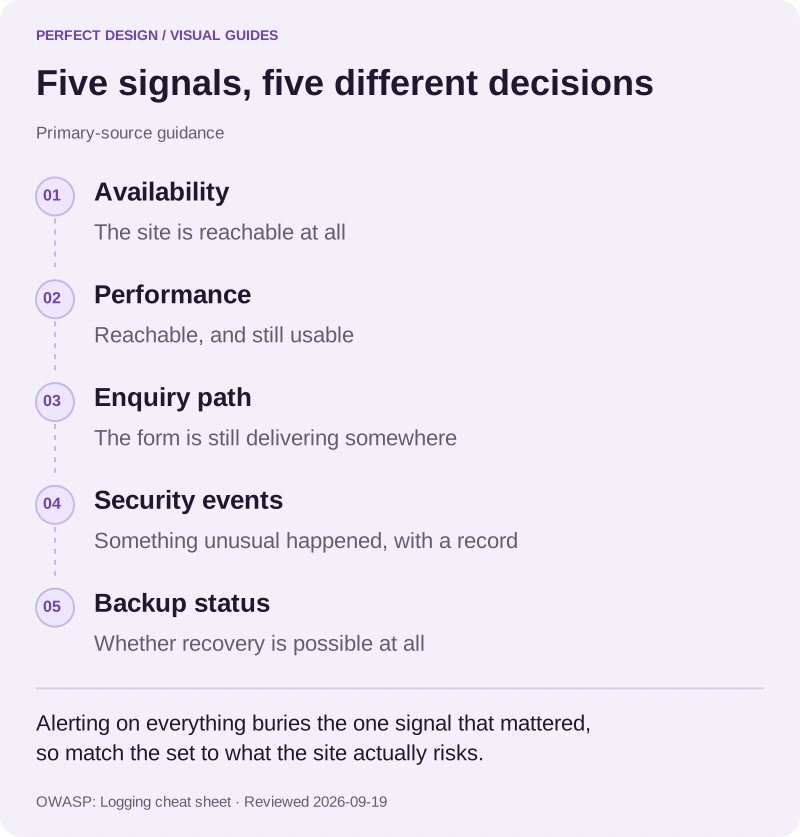
Group monitoring by the decision each signal supports. Availability says the site is reachable, performance says it is usable, an enquiry-path check says the form is still delivering, security events say something unusual happened, and backup status says whether recovery is possible at all. A brochure page and a live enquiry form do not need the same set.
OWASP's logging guidance helps here, with the caveat that it is general application-security advice rather than a monitoring design for your site. It says monitoring, alerting and reporting should be set during requirements and design and be proportionate to the information security risks, and warns that a blind checklist approach produces so much alarm noise that real problems go undetected.
Keep four things apart when reading a proposal: a signal detected, an alert reaching a named person, someone investigating it, and a business-level promise about uptime or recovery. The first three can be scoped. The fourth is a commitment, and belongs in writing only if someone agreed to it.

Five signals, five different decisions
Primary-source guidance. Alerting on everything buries the one signal that mattered, so match the set to what the site actually risks.
Source: OWASP: Logging cheat sheet. Reviewed .
Read the graphic as text
- Availability. The site is reachable at all
- Performance. Reachable, and still usable
- Enquiry path. The form is still delivering somewhere
- Security events. Something unusual happened, with a record
- Backup status. Whether recovery is possible at all
How updates are tested
The control around a single update
The control to look for is ordinary. Review the change, assess compatibility with the plugins, themes, integrations and custom code in use, apply it somewhere that is not the live site, confirm the backup position first, check the critical path afterwards, and record what was observed. Two conditions should pause all of it: recovery evidence nobody can produce, and a failed check on a path the business depends on.
What the WordPress documentation actually says
WordPress is still the most common platform behind sites we are asked to take over, and its documentation is worth quoting rather than paraphrasing. It recommends backing up the website first, so that if there are any issues you can restore it. It describes two paths: a one-click update that works for most people, and a manual process for when that fails. It warns that the upgrade affects all files and folders in the main installation, and that modifications made directly to those files will be lost. Whether a one-click update can write files at all depends on file ownership on the server.
That is documented platform behaviour, not a description of anyone's support scope. Which of those steps a provider performs, and what they answer for when one goes wrong, belongs in the agreement.

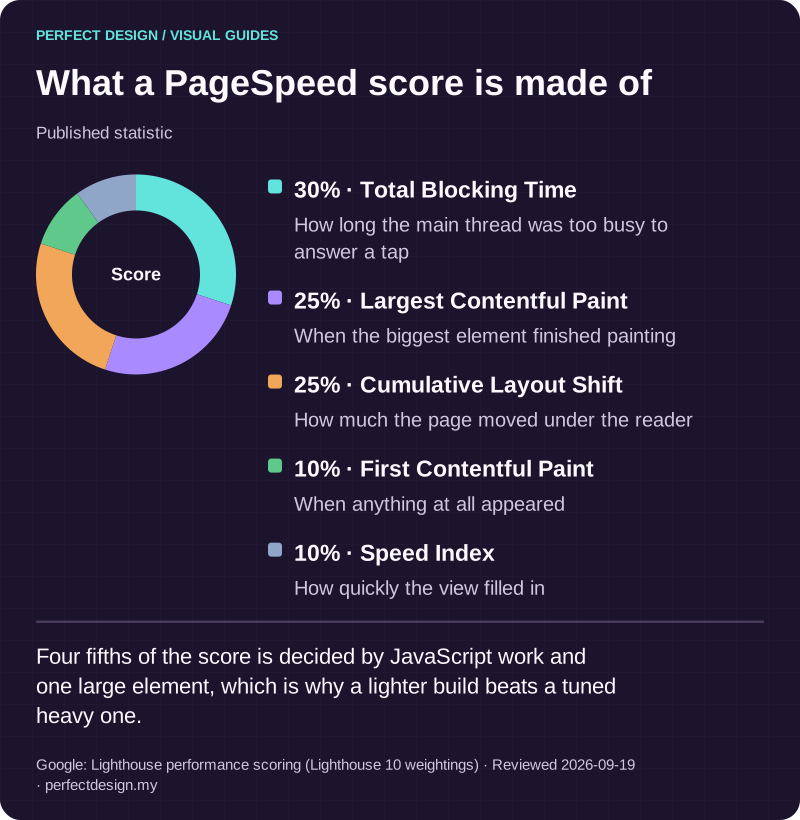
What a PageSpeed score is made of
Published statistic. Four fifths of the score is decided by JavaScript work and one large element, which is why a lighter build beats a tuned heavy one.
Source: Google: Lighthouse performance scoring (Lighthouse 10 weightings). Reviewed .
Read the graphic as text
Score
- Total Blocking Time: 30%. How long the main thread was too busy to answer a tap
- Largest Contentful Paint: 25%. When the biggest element finished painting
- Cumulative Layout Shift: 25%. How much the page moved under the reader
- First Contentful Paint: 10%. When anything at all appeared
- Speed Index: 10%. How quickly the view filled in
What happens after an outage or a compromise
The sequence, and the point where it escalates
An ordinary outage and a suspected compromise start the same way, then diverge. Identify the affected path, establish who has authority to act, preserve anything useful as evidence, then check what access and recovery evidence exists. Only then can you agree a correction, an investigation or a validated restore. Where access has been lost or the backup scope is uncertain, the honest response is escalation, not a promise to restore.
Logs are evidence, and evidence needs handling
During an investigation, the quality of your logs decides how much can be concluded. OWASP, again as general advice rather than a design for your site, says logs must record when, where, who and what for each event, with the action attempted and its result. It also treats logs as sensitive: passwords, keys, payment card data and session identifiers should be removed, masked, sanitised, hashed or encrypted, and access to log data should itself be recorded and monitored. It recommends testing that logging still works when something else fails.
So ask what is logged and who can read it before you need to know. And treat logs as context, not proof: they record what the system saw, which is not the same as establishing cause.
Which changes are included
Classify the request before anyone prices it
Most arguments about support are really arguments about classification. A useful scope names the categories in advance: routine care, content changes, new features, redesign work, search work and incident response. Anything touching an integration, permissions, a renewal or a journey the business depends on needs an impact review and an approval, whatever its technical size. Ask for the inclusions, the exclusions and the rule for a request that crosses between them.
Keep a record worth reading
The minimum useful record per request is short: affected area, risk, owner, approver, evidence requested, release state and follow-up decision. Routine approvals and incident escalations should not land in the same place. Compare who receives each record, because support nobody reports on is indistinguishable from support that is not running.

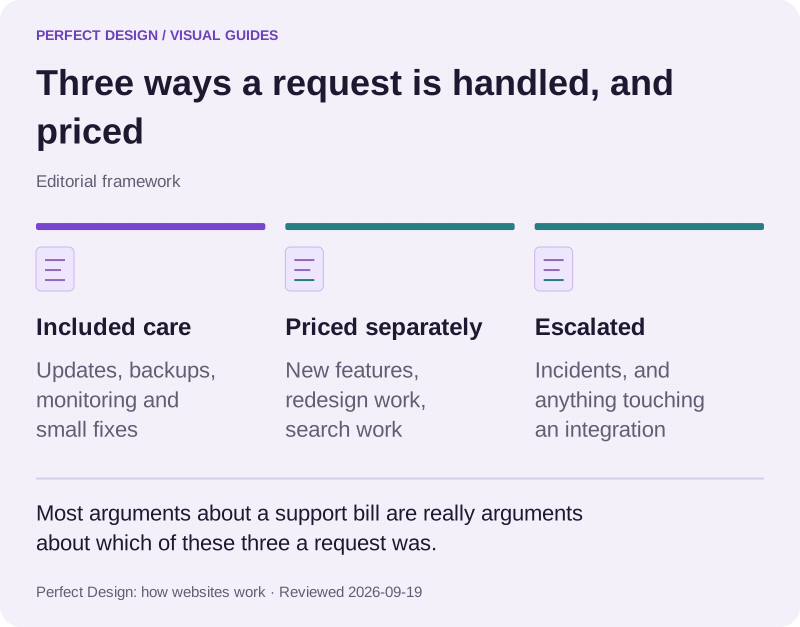
Three ways a request is handled, and priced
Editorial framework. Most arguments about a support bill are really arguments about which of these three a request was.
Basis: Perfect Design: how websites work. Reviewed .
Read the graphic as text
- Included care. Updates, backups, monitoring and small fixes
- Priced separately. New features, redesign work, search work
- Escalated. Incidents, and anything touching an integration
What care costs with us
Ongoing care for a front-end website starts from RM 1,000 a year and covers hosting, SSL, domain renewal and maintenance. For a more complex website or a system with a real backend, ongoing care starts from RM 250 a month, with the plan confirmed against what was actually launched. Care is quoted with the project rather than bolted on afterwards.
We normally respond in under one working day and work to solve problems as fast as we can. Rather than a ladder of support tiers, cover is scoped to what your site actually runs, so you are not paying for a level that does not apply to you. If your operation needs a formal response commitment written in, raise it and we will scope it. Build prices sit on the pricing page.
Before you agree a support scope
Prepare these and the conversation gets short.
- The website address and the problem you want to stop having
- Who is affected when it happens
- The platform and every external dependency you know of
- Who holds access, and who holds each renewal
- What the site has to do reliably
- Any constraint, such as a budget cycle or a regulated requirement
Then ask for the scope in writing: monitoring, backup and restore evidence, update responsibilities, included changes, reporting, escalation and account ownership. Ownership is the one to check first. If nobody can say who controls the domain, the hosting and the email, settle that before signing with anyone, including us.
Two of our client engagements show why care is scoped against what was launched. Sentrix Auto runs a brand site with a dealer portal and warranty records behind it, so an update touches more than pages. PITC Training was rebuilt off an ageing WordPress site into a course platform wired to a CRM. Both are real client work.
Send the address and the problem through the contact page and we will tell you what access we would need before we could say anything useful.