

On this page
Four words that are not synonyms
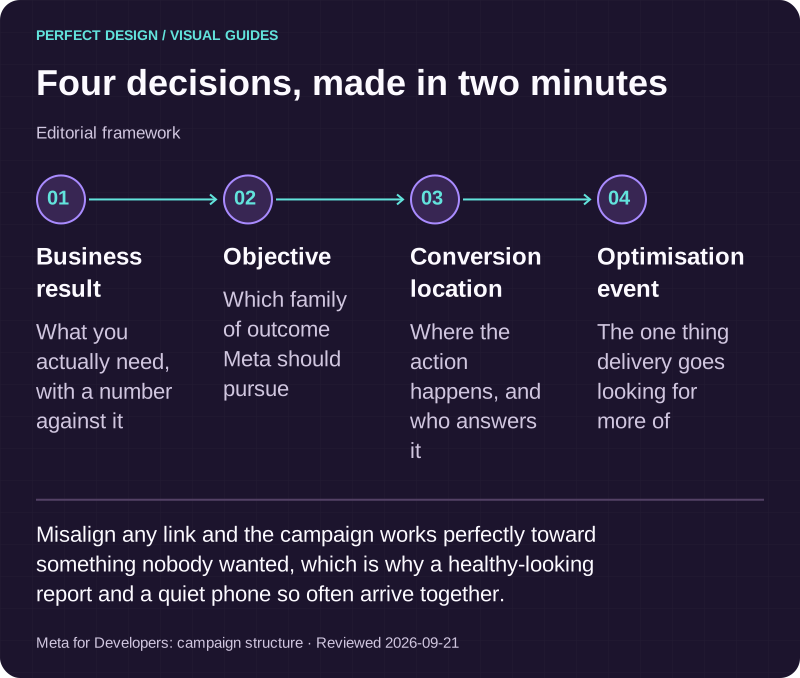
Before any of the settings make sense, separate these four. The business result is what you actually need — twelve booked installations, a hundred qualified enquiries, stock cleared before Raya. The objective is the campaign-level setting that tells Meta which family of outcome to pursue. The conversion location is where the action happens: your website, a messaging thread, a form inside the advert. The optimisation event is the specific action the delivery system will go looking for more of.
Meta's own structure puts these in different places. The objective sits on the campaign; the optimisation goal, the audience and the budget sit on the ad set. So two ad sets under one campaign can chase different events with different money — which is either a useful comparison or an accident, depending on whether anyone wrote it down.

Four decisions, made in two minutes
Editorial framework. Misalign any link and the campaign works perfectly toward something nobody wanted, which is why a healthy-looking report and a quiet phone so often arrive together.
Basis: Meta for Developers: campaign structure. Reviewed .
Read the graphic as text
- Business result. What you actually need, with a number against it
- Objective. Which family of outcome Meta should pursue
- Conversion location. Where the action happens, and who answers it
- Optimisation event. The one thing delivery goes looking for more of
The six objectives, and the business question each answers
Meta consolidated eleven older objectives into six outcomes: Awareness, Traffic, Engagement, Leads, App Promotion and Sales. The names sound interchangeable in a meeting and are not interchangeable in the system.
| Objective | What it pursues | When it is the honest choice |
|---|---|---|
| Awareness | Being seen and remembered by more of the right people | A launch, a new market, or a category nobody searches for yet |
| Traffic | Sending people to a destination | You genuinely need visits and can measure what happens next |
| Engagement | Actions on the ad, the post, the video, the event or the Page | Building an audience to retarget, or proving creative works before spending on conversions |
| Leads | Enquiries, including forms inside the ad itself | A service business whose sale starts with a conversation |
| App Promotion | Installs and in-app actions | The product is an app |
| Sales | Purchases and other high-value website or catalogue actions | You sell online and the purchase is measurable |
Conversion location decides who owns the follow-up
Within an objective you pick where the action happens, and Meta requires a destination type for outcomes such as Engagement and Leads — including one that keeps the action on the advert itself. The choice is not only technical. It decides who is responsible when somebody responds, and that is an operations decision as much as an advertising one.
- Your website. You own the page, the speed and the form, and the event can be measured on your side as well as Meta's. It also asks the most of the visitor.
- A messaging thread. Lowest friction, and a familiar shape in Malaysia, where a great deal of buying already happens in a conversation — but the enquiry now lives in a chat app, and somebody has to answer it within minutes, at night and on public holidays.
- A form inside the advert. Fewest steps, most volume, and the loosest intent: a person who never left the feed has invested nothing in you.
- Calls. Good for urgent services, useless if nobody picks up, and your own call log is the only honest record.
Each of these produces a different kind of lead at a different cost per lead, so comparing them on cost per lead alone will always flatter the loosest one. Compare them on what a hundred of them are worth after your team has tried to serve them.

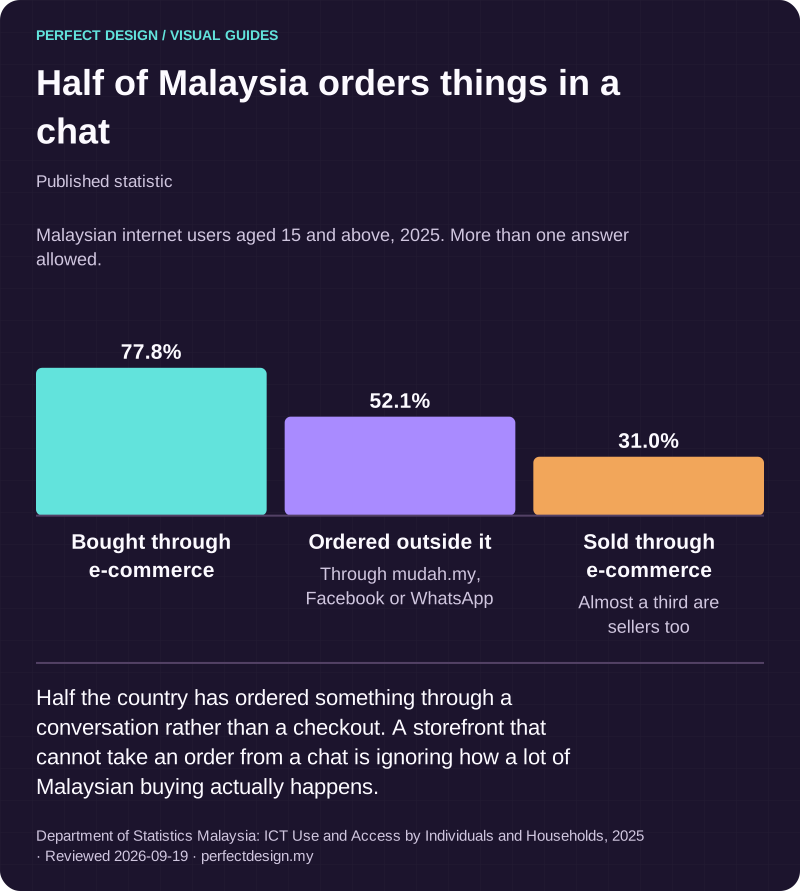
Half of Malaysia orders things in a chat
Published statistic. Half the country has ordered something through a conversation rather than a checkout. A storefront that cannot take an order from a chat is ignoring how a lot of Malaysian buying actually happens.
Source: Department of Statistics Malaysia: ICT Use and Access by Individuals and Households, 2025. Reviewed .
Read the graphic as text
- Bought through e-commerce: 77.8%.
- Ordered outside it: 52.1%. Through mudah.my, Facebook or WhatsApp
- Sold through e-commerce: 31.0%. Almost a third are sellers too
Chart scale: Malaysian internet users aged 15 and above, 2025. More than one answer allowed..
The optimisation event is an instruction, not a label
Whatever you nominate as the optimisation event, the delivery system will go and find more of it. That is the whole mechanism, and it is why the choice matters more than the objective name. It also runs into a hard constraint: Meta says ad sets leave the learning phase "as soon as they can deliver stably", which "usually occurs after about 50 results in the week after the ad set's last significant edit".
Fifty results a week of a rare event is a real budget. If your genuine purchase or qualified-enquiry volume cannot reach that, the ad set never stabilises, and its results stay noisy no matter how good the creative is. The usual answer is to optimise for an earlier event that happens often enough to teach the system, while continuing to judge the campaign on the rare one that pays the bills — not to declare the earlier event a success.

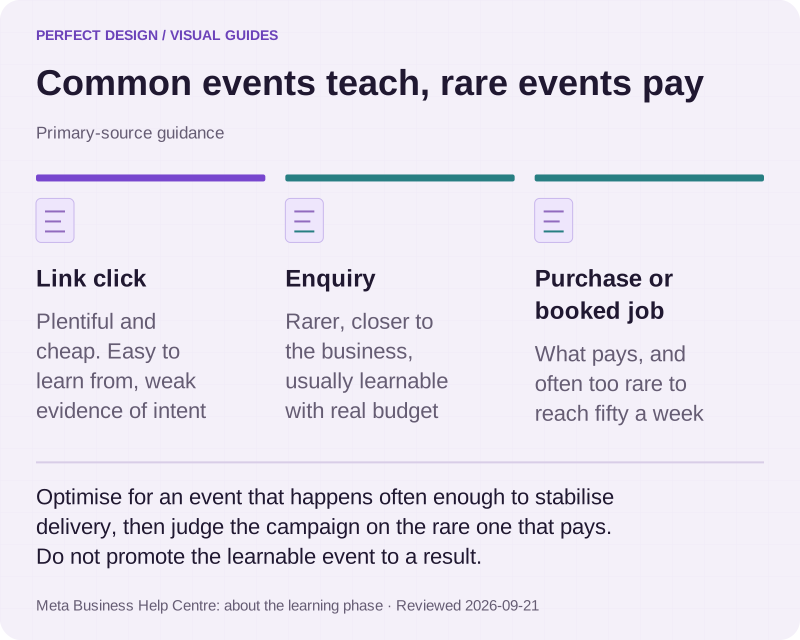
Common events teach, rare events pay
Primary-source guidance. Optimise for an event that happens often enough to stabilise delivery, then judge the campaign on the rare one that pays. Do not promote the learnable event to a result.
Source: Meta Business Help Centre: about the learning phase. Reviewed .
Read the graphic as text
- Link click. Plentiful and cheap. Easy to learn from, weak evidence of intent
- Enquiry. Rarer, closer to the business, usually learnable with real budget
- Purchase or booked job. What pays, and often too rare to reach fifty a week
A worked example, constructed
A Klang Valley company installs home water filtration. The business result is booked site visits. The sale needs a conversation, so the objective is Leads. The conversion location could be a website form or a WhatsApp thread, and they judge that in their market WhatsApp tends to produce more replies — so they choose messaging, on the condition that somebody is genuinely answering it.
Now the arithmetic. They want roughly twelve booked visits a month. If about one in four serious conversations becomes a visit, that is around fifty conversations a month — under fifteen a week, which is below the fifty results Meta describes for stable delivery. So they optimise the ad set for the start of a conversation rather than for a booked visit, and they keep two columns in the report: conversations the platform recorded, and visits their own diary confirms. The second column decides whether the campaign continues; the first only explains the delivery.
The assumptions worth writing down: that one in four ratio is theirs to measure, not ours to assert; the answering commitment is real work, not a setting; and if they later change the optimisation event, that is a significant edit and the learning clock restarts.
Judge the result in three layers
Keep three numbers apart in every report, and most arguments about Meta advertising disappear. What the platform recorded, on the attribution setting you chose — a setting with real consequences, since click-through counts events within 1 or 7 days of a link click while view-through counts them within 1 day of an impression. What your team confirmed was a real enquiry, from your own records. What is genuinely uncertain, including anything measured through aggregated methods after the iOS privacy changes.
A report that collapses those three into one figure is easier to read and worth much less. If the website is the conversion location, tie the browser and server events together with a shared event ID so the same action is not counted twice — the mechanics are on How Meta advertising works.
Settle these before launch
0 of 6 checked · saved on this device
The business result is written in one sentence, with a number
Evidence: Anyone on the team can repeat it without looking
The objective matches that result rather than the prettiest report
Evidence: The campaign objective in Ads Manager
The conversion location has a named person responsible for responding
Evidence: A name and the hours they cover
The optimisation event happens often enough to be learnable
Evidence: A realistic weekly count against the roughly fifty Meta describes
The attribution setting is recorded and left alone
Evidence: A note in the reporting template
Your own record of real enquiries exists separately from the platform
Evidence: A CRM, a spreadsheet or a diary that a human maintains
Where to go next
- How Meta advertising works →
The machinery around this decision: the auction, the learning phase, events and ownership.
- Meta Ads management →
What an engagement covers, and what to settle before any budget is committed.
- Landing page design →
If the conversion location is your website, the page is the other half of the decision.
- WhatsApp automation →
Where a messaging conversion location usually ends up, and where enquiries get lost.
Sources and further reading
- Meta for Developers: Simplifying campaign objectives with Outcome-Driven Ad Experiences — read 21 September 2026
- Meta for Developers: Campaign structure — read 21 September 2026
- Meta Business Help Centre: About the learning phase — read 21 September 2026
- Meta Business Help Centre: About ad auctions — read 21 September 2026
- Meta Business Help Centre: About attribution models and attribution settings — read 21 September 2026
- Meta for Developers: Handling duplicate Pixel and Conversions API events — read 21 September 2026