

On this page
The chain: crawling, indexing and ranking are three different things
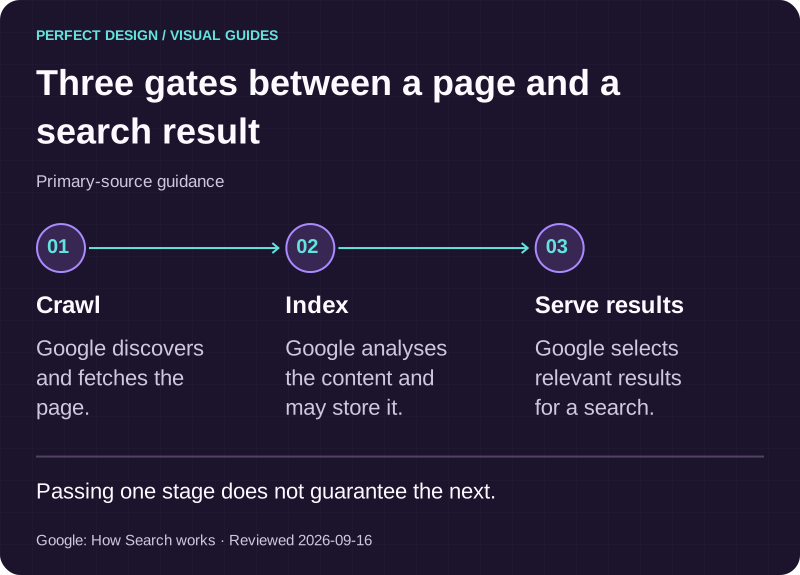
Google describes its own process in three stages. Crawling is discovery: automated programs follow links and sitemaps to fetch pages. Indexing is understanding and storage: Google renders the page, works out what it is about, decides whether it is a duplicate of another URL, and stores what it learned. Ranking happens at query time: for each search, Google picks from the index the results it judges most relevant and useful for that query, that language and that location.
The distinction matters because each stage fails differently. A page nobody links to and that is missing from the sitemap may never be crawled. A page that is crawled but blocked by a noindex directive, or judged a duplicate of another URL, is never stored as its own result. A page that is indexed but does not answer a query better than the alternatives simply is not shown for it. Treating all three as "we are not ranking" hides which one is broken.

Three gates between a page and a search result
Primary-source guidance. Passing one stage does not guarantee the next.
Source: Google: How Search works. Reviewed .
Read the graphic as text
- Crawl. Google discovers and fetches the page.
- Index. Google analyses the content and may store it.
- Serve results. Google selects relevant results for a search.
What a query is really asking for
A query is a task in a few words. "Web design Malaysia" might mean someone looking for an agency, someone comparing prices, someone researching the field, or a student. Google shows a mix of results when the intent is mixed, and a single type when it is clear. The practical consequence is that a page should be built to complete one task well, and its title, opening and structure should make that task obvious — to the reader first, and to the search engine as a result.
Demand estimates need the same care. Keyword Planner reports average monthly searches as rounded estimates for a location and language; they describe how often a query might be searched, not how many people would visit a page that ranks for it, and they say nothing about which result type Google shows. In our planning we treat a demand figure as a reason to look at the actual results for that query, never as a promise of traffic.
Entities, attributes and relationships
Search engines increasingly work with things rather than strings: a business, a product, a place, a person, and the facts attached to each. For a business website this means the same facts — name, address, phone, categories, services, opening hours, the people behind it — should agree everywhere they appear: on the site, on the Google Business Profile, on directories and on social profiles. Consistent, corroborated facts make it easier for a search engine to be confident about who you are; contradictory facts do the opposite.
Structured data is the machine-readable version of those facts. It helps a search engine read what the page already says; it does not add facts the page does not show, and it is not a ranking lever in itself. The guides below explain structured data and Business Profile foundations in detail.
What an internal link communicates
An internal link does three jobs at once. It gives a crawler a path to the destination, which is why pages with no links pointing at them — orphan pages — are often crawled late or not at all. It tells the reader where to go next for a related task. And the words of the link and the sentence around it describe what the destination is about. Google's own guidance asks for descriptive anchor text and crawlable links for exactly these reasons.
The useful test for any internal link is whether a reader who followed it would find what the anchor promised. Links added to hit a number, or with anchors like "click here", fail that test and add nothing. Navigation menus, breadcrumbs and contextual links in body text are different tools: menus orient, breadcrumbs show hierarchy, contextual links connect one task to the next.
External links and mentions
Links from other sites are one of the ways a search engine judges whether a page is trusted and referenced. What matters is independence and relevance: a mention from a site that has a real reason to reference you says more than a hundred placements bought from a network, and Google's spam policies explicitly treat link schemes as a violation. Counting referring domains without checking independence — the same sitewide footer link appearing on every page of one site is one relationship, not five hundred — produces numbers that look impressive and mean little.
The honest way to account for links is to record each one with its follow state, whether it points at your site directly or supports another placement, and whether it is still live. A submitted listing or a pitched article is not a link until it is published and observed.
Organic, local and AI surfaces
The classic list of ten blue links is only one surface. Local searches show a map with Business Profile listings, which depend on eligibility, the facts on the profile and the searcher's location rather than on the website alone. Image and video results, shopping results and, increasingly, AI-generated overviews and answers draw on the same index but select and present pages differently. Google states that its AI features use the same core signals and that no special markup is required to appear in them; being cited depends on being a clear, reliable source for the task.
For a Malaysian business the practical question is which surfaces your customers actually use for each task. A clinic is found on the map; a B2B supplier is found in organic results and increasingly in AI summaries; a retailer competes in shopping results too. The measurement has to match the surface: a grid of local observations for the map, exact result snapshots for organic, and Search Console for what Google reports across all of them.

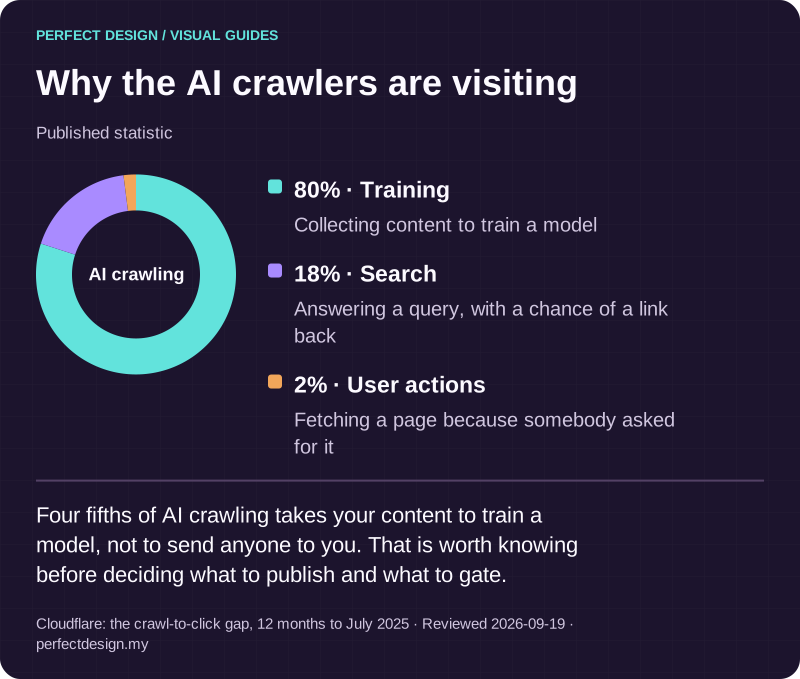
Why the AI crawlers are visiting
Published statistic. Four fifths of AI crawling takes your content to train a model, not to send anyone to you. That is worth knowing before deciding what to publish and what to gate.
Source: Cloudflare: the crawl-to-click gap, 12 months to July 2025. Reviewed .
Read the graphic as text
AI crawling
- Training: 80%. Collecting content to train a model
- Search: 18%. Answering a query, with a chance of a link back
- User actions: 2%. Fetching a page because somebody asked for it
What Search Console impressions and average position measure
Search Console's performance report is the closest thing to ground truth for a site's visibility, and it is easy to misread. An impression is counted when a link to your site appeared in a result set a user saw, subject to the report's rules about scrolling and result types. Clicks are clicks on that link. Average position is the average of the topmost position your site held across the impressions in the selection — an average across many queries, days, devices and countries, not the rank a particular person saw.
Two consequences follow. First, average position can move without anything changing on your site, because the mix of queries you appear for changed. Second, aggregate numbers hide the story: the useful reading is by query, by page, by country and by device, compared across two equal date ranges around a specific change. A guide to reading the reports this way is listed below.

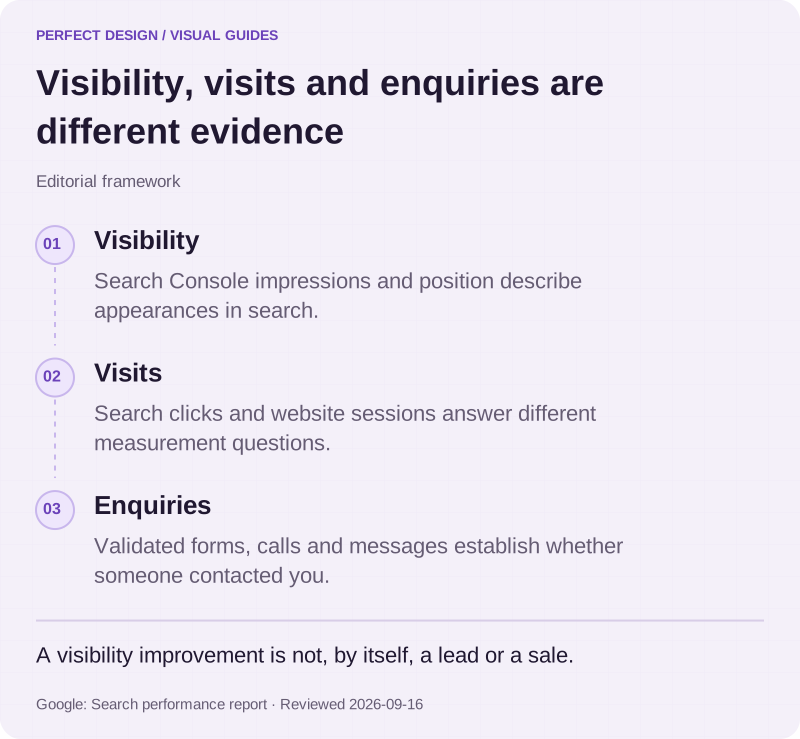
Visibility, visits and enquiries are different evidence
Editorial framework. A visibility improvement is not, by itself, a lead or a sale.
Basis: Google: Search performance report. Reviewed .
Read the graphic as text
- Visibility. Search Console impressions and position describe appearances in search.
- Visits. Search clicks and website sessions answer different measurement questions.
- Enquiries. Validated forms, calls and messages establish whether someone contacted you.
How this shapes the way pages are planned
Put the chain together and a planning rule falls out: give every important task one accountable page, make that page discoverable and indexable, make it the clearest answer to the task, connect it to the pages before and after it in the reader's journey, and measure it at the stage where it can fail. Pages that exist for a keyword variant rather than a task compete with their siblings and dilute all of them.
This is the model behind our SEO programmes: measure first, fix the stages that block discovery and indexing, build pages around real tasks, earn independent mentions, and report what was observed at each stage rather than a single score.

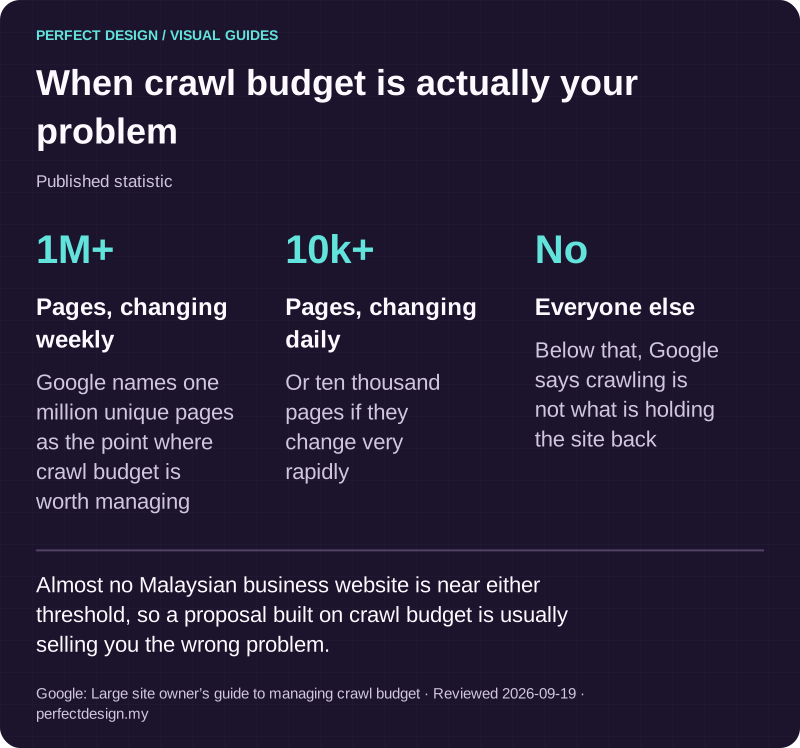
When crawl budget is actually your problem
Published statistic. Almost no Malaysian business website is near either threshold, so a proposal built on crawl budget is usually selling you the wrong problem.
Source: Google: Large site owner’s guide to managing crawl budget. Reviewed .
Read the graphic as text
- Pages, changing weekly: 1M+. Google names one million unique pages as the point where crawl budget is worth managing
- Pages, changing daily: 10k+. Or ten thousand pages if they change very rapidly
- Everyone else: No. Below that, Google says crawling is not what is holding the site back
What to do next
- Open Search Console for your site. If it is not verified, that is the first job — nothing about visibility can be measured without it.
- Pick five queries that matter to your business and search them from a Malaysian location. Note which surface answers them: map, organic, shopping, an AI overview.
- For each query, decide which single page on your site should answer it. If the answer is "none" or "several", that is the gap to plan around.
- Use the guides and checklists below to check the stage you suspect is failing, starting with indexing.
Guides and checklists
Choose the task you need help with: understand the evidence, investigate a problem or check completed work.
Foundations
- How Websites WorkHow a website actually works, from browser request to hosting, content management, design and accessibility, and who owns each part after launch.Guide
- How Ecommerce WorksHow ecommerce works end to end: products and catalogues, carts and checkout, payments and settlement, stock, fulfilment and the records behind an order.Guide
- Mobile Applications ExplainedHow mobile applications are built, connected, distributed and maintained: native and cross-platform, permissions, offline state and the release lifecycle.Guide
- Business software and connected systems explainedHow business software fits together: records, roles, workflows, integrations and the exceptions that decide whether a connected system actually holds up.Guide
- AI assistants, automation and business data explainedHow AI assistants, retrieval and automation actually work, where a language model can be confidently wrong, and why customer-facing work needs a human path.Guide
Measurement and diagnosis
- How a six-month SEO programme worksWhat gets measured first in an SEO programme, which workstreams depend on others, how six months are sequenced, and what none of it can promise.Guide
- Complete SEO Audit GuideWhat a complete SEO audit covers, how checks are marked measured, partial or unavailable, and how fixes get verified in the reports that found them.Guide
- Search Console for SEO MeasurementWhat Search Console impressions, clicks and average position measure, how to segment them properly, and how to connect a change to an outcome.Guide
Keyword and audience research
Topical architecture and internal links
Crawling, indexing and technical controls
- Robots, Noindex and Canonical ControlsWhich control affects crawling, which affects indexing, what happens when noindex and a canonical conflict, and how to verify a URL's effective state.Guide
- Technical SEO Audit ChecklistAn evidence-led technical SEO checklist: discovery, rendering, indexability, canonicals, redirects, sitemaps, status codes and migration risk.Checklist
Page experience and performance
Structured data and entities
Local search
- Google Business Profile Foundations for Malaysian BusinessesWho is eligible for a Google Business Profile, which facts must be accurate, storefront versus service area, and a Malaysian evidence checklist.Guide
- Local SEO Checklist for Malaysian BusinessesAudit the local search foundations of a Malaysian business: entity consistency, profile ownership, location pages, citations, reviews and measurement.Checklist
Paid advertising
- How Google Ads WorksHow Google Ads works end to end: search terms against keywords, the per-search auction, what a daily budget really does, conversion measurement and policy.Guide
- Shopping Ads vs Search Ads vs Performance MaxWhat each Google campaign type needs before it can run, where control sits, how they compete with each other, and how to choose without guessing.Guide
- How Meta Advertising WorksHow Facebook and Instagram ads work: the three account levels, the total-value auction, the learning phase, creative, and measurement after the privacy changes.Guide
- Choosing a Meta Ads ObjectiveBusiness result, objective, conversion location and optimisation event are four separate decisions. What each controls on Facebook and Instagram, and how to choose.Guide
Where to go next
- SEO programmes for Malaysian businesses →
How we turn this chain into a measured six-month plan.
Rather have this handled?
This is part of how we run seo programmes for Malaysian businesses. Ask us about your site — no pitch, a straight answer.
Sources and further reading
- Google Search Central — In-depth guide to how Google Search works — read 15 September 2026
- Google Search Central — Search Engine Optimization (SEO) Starter Guide — read 15 September 2026
- Google Search Central — Creating helpful, reliable, people-first content — read 15 September 2026
- Google Search Central — Link best practices for Google — read 15 September 2026
- Google Search Central — AI features and your website — read 15 September 2026
- Search Console Help — Performance report (Search results) — read 15 September 2026
- Google Ads Help — About Keyword Planner forecasts and historical metrics — read 15 September 2026
- Google Business Profile Help — Guidelines for representing your business on Google — read 15 September 2026