

Nobody was looking for you
There is no search box on Facebook or Instagram. The person is catching up with people they know, and your advert arrives uninvited between two things they chose to look at. Everything about the channel follows from that. The advert has to earn attention almost immediately, the message has to make sense to somebody who was not thinking about your category, and the offer has to be understandable without the context a searcher brings. It is why a search advert rewritten for a feed usually does nothing.
It is also why the channel does things search cannot. You can introduce something nobody would think to search for, reach people before they are in the market, and show a product visually instead of waiting for someone to describe it in words. The trade is that you carry the whole burden of interest yourself.

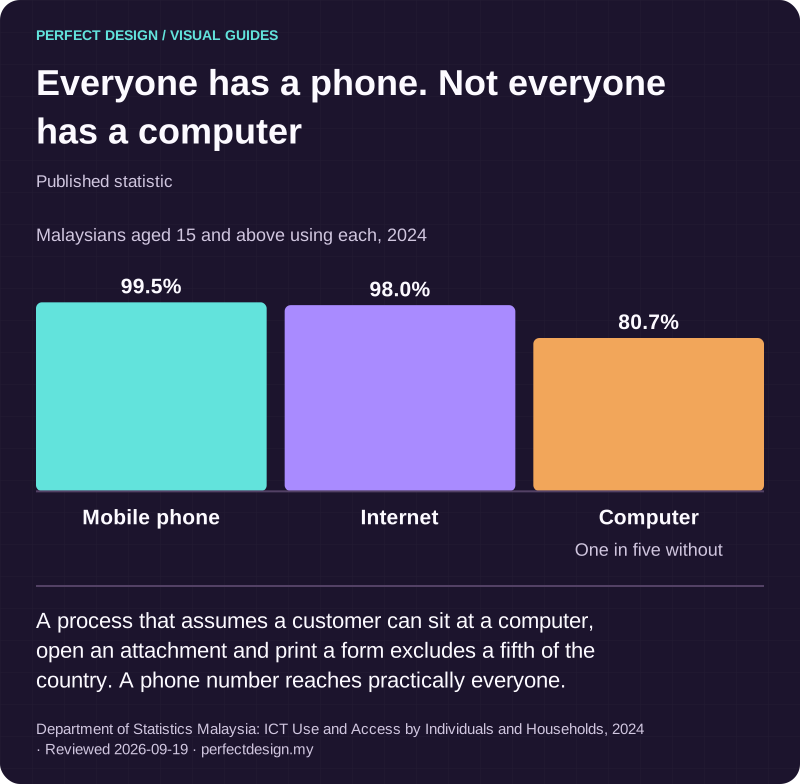
Everyone has a phone. Not everyone has a computer
Published statistic. A process that assumes a customer can sit at a computer, open an attachment and print a form excludes a fifth of the country. A phone number reaches practically everyone.
Source: Department of Statistics Malaysia: ICT Use and Access by Individuals and Households, 2024. Reviewed .
Read the graphic as text
- Mobile phone: 99.5%.
- Internet: 98.0%.
- Computer: 80.7%. One in five without
Chart scale: Malaysians aged 15 and above using each, 2024.
Where the decisions actually sit
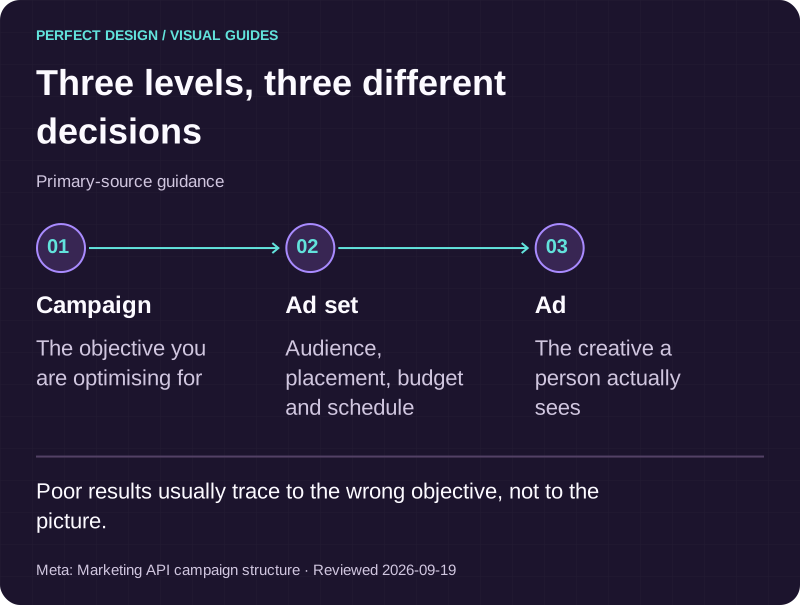
Meta's developer documentation sets out the structure plainly, and knowing which level owns which decision saves a great deal of confused conversation. A campaign is the highest level and should represent a single objective. Budget, billing, duration, audience and bidding are set at the ad set level and apply to every ad in the set. The ad itself carries the creative.
| Level | What is decided there | What that means in practice |
|---|---|---|
| Campaign | The objective, as one goal for everything beneath it | Change it and you change what the system optimises toward. It is not a label |
| Ad set | Budget, schedule, bidding and audience | Where spend is controlled, and where an audience comparison is set up or ruined |
| Ad | The creative: image or video, the copy and the destination | Where most of the testing should happen, and the part most often left untouched for months |

Three levels, three different decisions
Primary-source guidance. Poor results usually trace to the wrong objective, not to the picture.
Source: Meta: Marketing API campaign structure. Reviewed .
Read the graphic as text
- Campaign. The objective you are optimising for
- Ad set. Audience, placement, budget and schedule
- Ad. The creative a person actually sees
The creative carries the campaign
In a feed, targeting decides who is eligible to see something and the creative decides whether any of them stop. So the work that matters is producing enough genuinely different ideas to learn something, rather than producing one advert and adjusting its button colour.
Different has to mean different: a different opening moment, a different claim, a different format, a different person on screen, a different problem named first. Variations on one idea teach you nothing, because when they perform alike you still do not know which idea was wrong.
- Write for sound off. Assume the video is muted and the first frame is all you get. Captions and on-screen text are not an accessibility afterthought, they are the advert.
- Say the thing first. The offer, the problem or the product belongs in the opening moment, not after a branded title card.
- One idea per advert. An advert making three arguments makes none of them well and cannot be interpreted afterwards.
- Build for vertical. Stories and Reels placements are full-screen vertical. A landscape video cropped into them looks like it was made for somewhere else, because it was.
- Plan for fatigue. Creative wears out against the same audience, so replacement is scheduled work rather than an emergency.

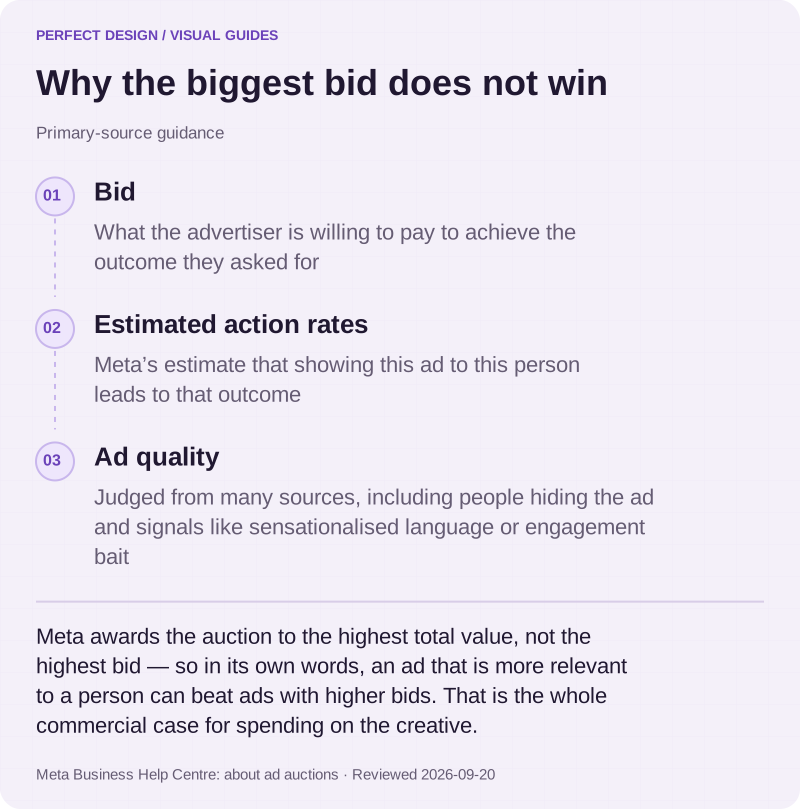
Why the biggest bid does not win
Primary-source guidance. Meta awards the auction to the highest total value, not the highest bid — so in its own words, an ad that is more relevant to a person can beat ads with higher bids. That is the whole commercial case for spending on the creative.
Source: Meta Business Help Centre: about ad auctions. Reviewed .
Read the graphic as text
- Bid. What the advertiser is willing to pay to achieve the outcome they asked for
- Estimated action rates. Meta’s estimate that showing this ad to this person leads to that outcome
- Ad quality. Judged from many sources, including people hiding the ad and signals like sensationalised language or engagement bait
Audiences, and the limits of targeting
Meta documents custom audiences built from customer information such as email addresses and phone numbers, and requires that the data is shared in a hashed format to maintain privacy, with personally identifying fields hashed before upload. Two things follow. Your customer list is a genuine asset in this channel, and handling it carries legal weight, so who uploads what and on what basis belongs in the scope rather than in an afterthought.
The honest limit is that narrow targeting is not the advantage it is sold as. Delivery systems now do much of the finding, and an audience cut too thin mainly restricts what the system has to work with. Interest targeting also describes inferred interest rather than intention: somebody interested in a category is not somebody buying this month. We would rather put the effort into the creative and into an audience wide enough to learn from, then tighten where the evidence supports it.

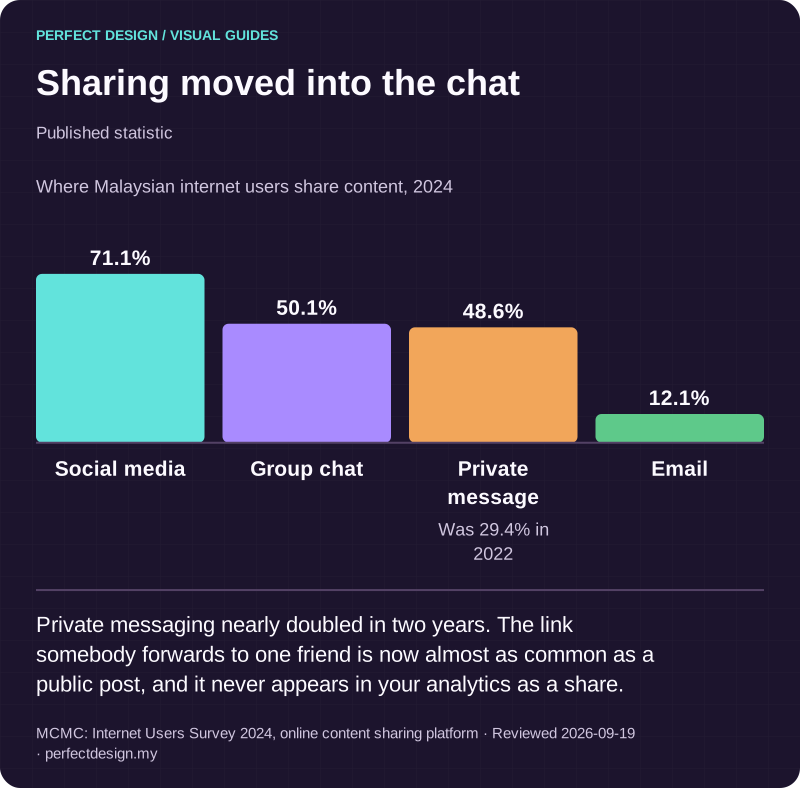
Sharing moved into the chat
Published statistic. Private messaging nearly doubled in two years. The link somebody forwards to one friend is now almost as common as a public post, and it never appears in your analytics as a share.
Source: MCMC: Internet Users Survey 2024, online content sharing platform. Reviewed .
Read the graphic as text
- Social media: 71.1%.
- Group chat: 50.1%.
- Private message: 48.6%. Was 29.4% in 2022
- Email: 12.1%.
Chart scale: Where Malaysian internet users share content, 2024.
What the iOS privacy changes did to measurement
Apple's App Tracking Transparency prompt, introduced with iOS 14.5, lets people decline tracking across other companies' apps and websites. Meta documents Aggregated Event Measurement as a way to measure app events from users on iOS 14.5 and later who have opted out of app tracking, which tells you something without needing a statistic: opting out is common enough that the platform built a separate, aggregated measurement method for it.
The practical consequences are worth accepting early rather than arguing with later. Platform numbers and your own records will not agree, and the gap is not proof that either is broken. The attribution window the platform reports on may not be the one you assume, and some of what it shows is aggregated rather than counted person by person. So decide before launch which system is your source of truth for a sale or an enquiry. In our experience that should be your own records, with the platform used to compare one advert against another rather than to count the business.

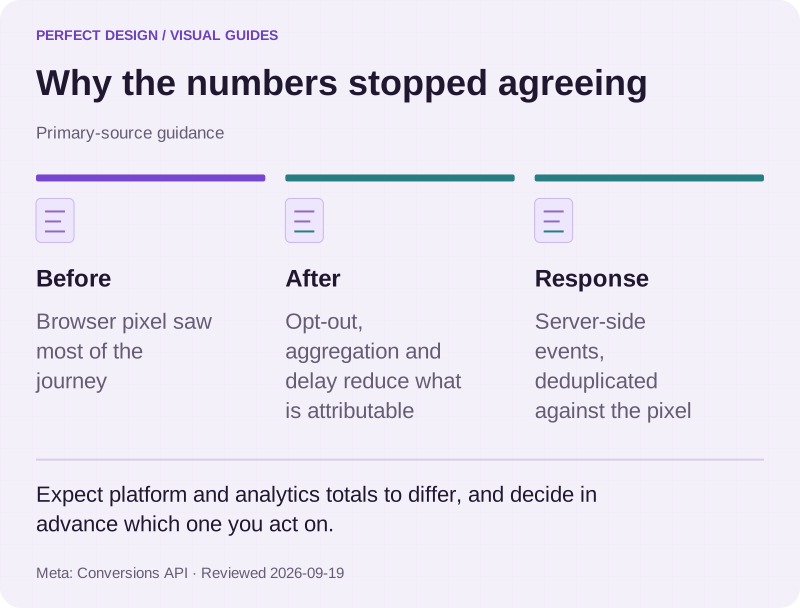
Why the numbers stopped agreeing
Primary-source guidance. Expect platform and analytics totals to differ, and decide in advance which one you act on.
Source: Meta: Conversions API. Reviewed .
Read the graphic as text
- Before. Browser pixel saw most of the journey
- After. Opt-out, aggregation and delay reduce what is attributable
- Response. Server-side events, deduplicated against the pixel
The Conversions API, in plain terms
The Meta Pixel is JavaScript running in a visitor's browser, so anything that interferes with a browser interferes with it: a blocker, a privacy setting, a poor connection, a person leaving before the page finishes. The Conversions API is the server-side route. Meta describes it as creating a connection between an advertiser's marketing data from their server, website platform, mobile app or CRM and Meta systems, and documents that server events are processed in a similar way to events sent by the Pixel.
Sending both is the normal arrangement, and then the two have to be reconciled or the same purchase is counted twice. Meta documents the requirement: the Pixel's event identifier must match the Conversions API event_id, the Pixel's event must match the event_name, and events are deduplicated when received within 48 hours of the first event carrying that identifier. Get the identifiers wrong and both copies count, which quietly inflates every conversion figure you then make decisions with. This is a build task on your website, not a switch in the ad account, so it belongs with whoever owns the site.
Who owns the accounts and the spend
Your business owns the ad account, the billing profile and the data in them, and media budget is paid to the platform by you rather than through us. Meta has a specific trap worth checking before the first ringgit is spent: the Facebook page, the Instagram account, the pixel and the ad account should all sit inside a business portfolio your company controls, not inside an individual's personal profile or a previous agency's. Recovering an asset nobody at your company administers is slow at best. Reporting is agreed with you at the start: what ran, what it cost, what your team qualified and what remains uncertain.
When we would point you somewhere else
If people only buy at the moment a specific problem appears and they go to a search engine to describe it, interruption is the harder road and paid search is the more direct one. If your category lives on short vertical video and a younger audience, TikTok Ads, which we also manage, is a different creative job again. And if enquiries already go unanswered for days, no channel fixes that.
The destination matters as much as the advert. Sending feed traffic to a homepage wastes most of it, so a campaign usually needs a landing page built for one offer, and for a store the work sits in the product and checkout path rather than the advert. Our e-commerce development page covers that side. Where you are also trying to be found rather than only seen, SEO answers a different question and the two are worth planning together.
What to bring to a scoping conversation
Bring the offer and who it is for, the destination, any photography or video you already own, who can approve a claim, who administers the Facebook and Instagram assets today, and what counts as a genuine enquiry. That is enough for us to say what is included, what has to be built first, and whether we would recommend starting at all.